Monday, 18 February 2013

I'm a woman, not a small man!


Do you think that martial arts are institutionally sexist? I'm not saying that they are or that they’re not, I'm just asking the question.

I sometimes feel like a square peg in a round hole when it comes to my training and the harder I think about this the squarer becomes the peg and the rounder becomes the hole! If I don’t think about it then I fit in perfectly well in my club and don’t perceive there to be any problem at all.

Have I confused you yet? The problem is when I just concentrate on learning the art of karate (or jujitsu or kobudo as I have in the past) then it all seems very relevant to me and I enjoy learning it all. BUT when I think about my own personal self-defence needs I realise that a lot of what I learn is not terribly relevant to women, or is, at least, not presented in a way that is relevant to women.

The self-defence aspect of martial arts is not sexist but it is male-centric, i.e. it generally revolves around the needs of men and the self-defence scenarios that they may encounter. Women are being trained to fight like men. This is not surprising since martial arts were developed by men to teach men to fight other men. Yes, I know Wing Chun was allegedly developed by a woman but it still mainly teaches its practitioners to fight like men.

I suspect most instructors don’t think about it like this – they treat all their student’s the same (so in that sense it is not sexist) but they just treat everyone like a man – women are trained as if they are just small men.

Lots of people tell me that strength is not important to make a technique work and that most techniques can be adjusted slightly to help small people make them work on big people. I don’t doubt this (well sometimes I do) – I have witnessed small (but stocky) women throwing much bigger partners - in the artificial environment of the dojo. However would you ever advise a woman to move in for a hip throw in a real situation in the street? Isn't it expecting a lot for a woman to execute this successfully? Doesn't she put herself at greater risk moving into position for such a throw?

Perhaps we shouldn't ask can this technique be altered so that a woman can do it but rather should she be taught this technique at all? Is there something more appropriate to teach her?

Is there any danger in teaching women to defend themselves like men, particularly if they don’t even realise that is what they are doing? After all, women will not be attacked like men. Men attack women differently to the way they attack other men.  

Men will often find themselves attacked in a ‘monkey brain’ scenario – they get into an argument, tempers rise, they square up to each other, a cascade of hormones is released and a fight kicks off – others may join in and the ‘multiple attacker’ scenario ensues, often in public (a bar, football ground or just in the street). The attacker(s) reigns lots of punches and possibly kicks at the defender who defends his head until he can get some sort of counter-attack in. The defender may have been verbally ‘provoked’ into the altercation but he will not have been ‘groomed’. Women don’t generally face this type of scenario.

Women face a more ‘predator-prey’ situation. There may or may not be a period of ‘grooming’ before hand, e.g. ‘chatting up’ in the pub to gain trust, followed by being separated from friends to isolate them. The attack will then happen privately away from public view, usually by being grabbed first and verbally threatened with violence if they scream. A woman may be taken to another place to be raped/murdered. Or the isolation and violence may occur in her own home by her own partner. These are worse case scenarios for most women but the ones they fear most.

Of course men and women can face similar attacks too – road rage/trolley rage attackers, car park assaults/car thefts, random street attacks by unsupervised psychotic patients etc so I’m not saying there’s no overlap at all, there clearly is but there are also many differences.

Adding to all this, women are also psychologically different to men. They differ in their experiences of violence growing up (girls tend to avoid playground fights and are more cooperative and less competitive with each other) which affects their perception of an attack and their initial response to it (women can be over-trusting of strangers but experience greater levels of paralysing fear).

The physical (generally smaller, weaker stature) and mental (more trusting but more easily frightened by real violence) differences of women compared to men make some self-defence techniques less suitable for women. For example:

·         Punching. Most women have small fists compared to most men. However hard they can hit for their size they are unlikely to inflict any damage on an adrenaline fuelled attacker, they are more likely to hurt themselves. Women are better to train with open hand techniques striking soft (vital point) targets of the body and head.

·         Throwing. Like I said before – just because they can doesn't mean they should. Moving towards an attacker to position for a throw makes a woman very vulnerable to being grabbed and controlled.

·         Locks. These can be notoriously difficult to apply in a ‘fight’ situation anyway and doubly so for small female hands against the adrenaline fuelled large, strong limbs of an attacker.

·         Multiple attacker training. Apart from the very rare situation of ‘gang’ rape (more common in war zones where it is used as a weapon, but I’m not talking about war) women don’t face multiple attack scenarios so it is better to focus more on predator-prey situations.

There is a mismatch when women, training in male-centric environments, are trained to defend themselves like men when they will be attacked like women. There is a risk that they will be trained in in-effective strategies for the situations they face.

Do you agree?

Remember - I'm a woman, not a small man! (I might have this put on a t-shirt!)


Bookmark and Share
Creative Commons License
This work is licensed under a Creative Commons Attribution-Noncommercial-Share Alike 2.0 UK: England & Wales License.

Tuesday, 5 February 2013

Taiji seminar revisited...


Following my last posting on taiji, Joe Harte has kindly written to me and filled in a few gaps in my understanding. I thought I would share them with you. Below is a re-post of part of my original post with Joe's comments inserted in blue type....

Joe Harte
Last Saturday my husband and I attended a taiji seminar in Durham with experienced taiji instructor Joe Harte, whom I met and become acquainted with through my activities with the annual Marfest event last year.

We like to talk about internal and external arts and generally find our own art categorised into one of these groups without fully appreciating why or what it really means. I’m well aware that karate is categorised as an external art yet in karate we talk about (a lot) and practice (to a lesser extent) breath control, mind-body-spirit unity, altered mind states such as mushin (empty mind) and zanshin (aware mind). On the surface these seem like ‘internal’ elements yet karate remains doggedly an external art! Why? And what, therefore, is an internal art?

[ Internal / external? Originally I’m told the Chinese would refer to arts from outside china as external. But that has changed over the years and now usually is a way of referring to arts that train the mind to use intention, awareness, and energetic responses, sometimes with breath. Few however know or use the stretching muscle to generate power which has far greater potential than using contracting muscle states to develop power. See my teachers recent interview where he discusses what makes an ‘internal’ art:  http://www.taichination.com/latest.php?id=117  ]

These were questions I wanted to answer. Joe had intrigued me with something he said last year along the lines of “…Master Huang changed this form so that on the outside it looked exactly the same but on the inside felt very different….” How can something be changed to look the same on the outside but be very different in the way itfeels?

[ Master Huang 1910-1992 had studied Fujian White Crane from the age of 14 with some of the famous masters of the time. It seems the Yang Fast form died out so later in his life he introduced the Form  Er shi Ba from the white crane to the Taiji world. Slowly he changed the emphasis of this fast form over a lifetime of study to internally harmonize with the Taiji principles. So now the Quickfist that we train is externally the same, but internally changed  towards that of Taiji]

I knew the only way I was going to gain any insight into what an internal art really is was to go and experience it for myself. Having fortuitously met Joe I now had the means and opportunity to do this so I booked us onto the seminar….

Joe had warned me to dress up warm – several layers, hat, gloves, scarf etc, and wear flat shoes. “You won’t get sweaty in a taiji class,” he warned nor could he guarantee the heating would be on. Like many people I had a mental image of doing forms in a slow, relaxed way. I knew that more than that must be going on but wasn't quite sure what.
[sorry about the hall heating!]

We arrived a bit late due to the adverse weather conditions- the heavens had decided to drop another 3 inches of snow all over Britain on Friday night meaning there had been very little time for the gritters and snow ploughs to get the roads clear. The class was already doing some gentle warm up exercises so we just quietly got ready and joined in at the back.

The general etiquette and atmosphere in the class was much more relaxed and informal than in a karate class – no waiting to catch sensei’s eye to bow you onto the training area or giving you punishment press-ups because you are late! In fact, no bowing (or press-ups) at all.
[The relaxed atmosphere is more typical in Taiji classes. Also rather than belts people are recognized by the subtlety of their training, although some Taiji schools use uniforms and belts we don’t.  People are more or less free to express themselves allowing to see more of their true nature, whereas strict etiquette or outer rules would potentially block this. Seeing this helps people understand themselves in their effort to slowly change]

After the warm up exercises Joe explained that we were going to do Master Huang’s 5 loosening exercises. My interpretation was that these exercises are partly designed to help you relax your body and muscles properly and partly to start you on the path to discovering your ‘deep mind’. Joe talked us through these exercises instructing us on the external movements required and how we were supposed to be thinking and feeling on the inside, teaching us how to listen to our internal senses rather than just relying on our external senses.
We are all familiar with our external senses – sight, hearing, touch, smell and taste but not very familiar at all with our internal ones, which were defined as temperature, pressure, pain, muscle state and joint position. The idea seems to be to try and connect with the part of the unconscious mind that generally controls these senses automatically – the deep mind or Joe sometimes referred to it as the ‘body’s mind’. So as we went through the loosening exercises we were encouraged to think about the pressure experienced on our feet as our weight shifted about or about whether certain muscles were in a state of contraction or relaxation. [ the shift from external senses to internal ones is not at all easy. As the body moves the superficial mind ‘listens’ more easily to the gross outer movement, this masks the much more subtle internal sensations which are listened to by a deeper part of the mind – this takes long long training – discussed in part in my article Milestones in the Mist http://www.communigate.co.uk/ne/taijiquan/page9.phtml  ]
See my previous post for the rest of my discussion about this seminar

Bookmark and Share
Creative Commons License
This work is licensed under a Creative Commons Attribution-Noncommercial-Share Alike 2.0 UK: England & Wales License.

Tuesday, 29 January 2013

My experiences of a taiji seminar


Last Saturday my husband and I attended a taiji seminar in Durham with experienced taiji instructor Joe Harte, whom I met and become acquainted with through my activities with the annual Marfest event last year.

We like to talk about internal and external arts and generally find our own art categorised into one of these groups without fully appreciating why or what it really means. I’m well aware that karate is categorised as an external art yet in karate we talk about (a lot) and practice (to a lesser extent) breath control, mind-body-spirit unity, altered mind states such as mushin (empty mind) and zanshin (aware mind). On the surface these seem like ‘internal’ elements yet karate remains doggedly an external art! Why? And what, therefore, is an internal art?

These were questions I wanted to answer. Joe had intrigued me with something he said last year along the lines of “…Master Huang changed this form so that on the outside it looked exactly the same but on the inside felt very different….” How can something be changed to look the same on the outside but be very different in the way it feels?

I knew the only way I was going to gain any insight into what an internal art really is was to go and experience it for myself. Having fortuitously met Joe I now had the means and opportunity to do this so I booked us onto the seminar….

Joe had warned me to dress up warm – several layers, hat, gloves, scarf etc, and wear flat shoes. “You won’t get sweaty in a taiji class,” he warned nor could he guarantee the heating would be on. Like many people I had a mental image of doing forms in a slow, relaxed way. I knew that more than that must be going on but wasn't quite sure what.

We arrived a bit late due to the adverse weather conditions- the heavens had decided to drop another 3 inches of snow all over Britain on Friday night meaning there had been very little time for the gritters and snow ploughs to get the roads clear. The class was already doing some gentle warm up exercises so we just quietly got ready and joined in at the back.

The general etiquette and atmosphere in the class was much more relaxed and informal than in a karate class – no waiting to catch sensei’s eye to bow you onto the training area or giving you punishment press-ups because you are late! In fact, no bowing (or press-ups) at all.

After the warm up exercises Joe explained that we were going to do Master Huang’s 5 loosening exercises. My interpretation was that these exercises are partly designed to help you relax your body and muscles properly and partly to start you on the path to discovering your ‘deep mind’. Joe talked us through these exercises instructing us on the external movements required and how we were supposed to be thinking and feeling on the inside, teaching us how to listen to our internal senses rather than just relying on our external senses.

We are all familiar with our external senses – sight, hearing, touch, smell and taste but not very familiar at all with our internal ones, which were defined as temperature, pressure, pain, muscle state and joint position. The idea seems to be to try and connect with the part of the unconscious mind that generally controls these senses automatically – the deep mind or Joe sometimes referred to it as the ‘body’s mind’. So as we went through the loosening exercises we were encouraged to think about the pressure experienced on our feet as our weight shifted about or about whether certain muscles were in a state of contraction or relaxation.

To aid our understanding we broke off to do a partner exercise in which one partner took the weight of the others outstretched arm (stretched out horizontally to the side). You then had to gently lift your arm a fraction from the partners hold by first contracting the shoulder muscle, then the upper arm muscles to lift the elbow and finally the lower arm muscles to lift the wrist and hand. Then you had to relax the muscles in the same order – shoulder, upper arm then lower arm, resting your arm back onto the partners hold. If you had managed to completely relax the arm it should feel heavy to the person holding it and if they withdrew their hold then your arm should drop under its own weight. When I held my partner’s arm in a relaxed state it felt like a bar of lead. When he held mine and gently withdrew his hold my arm stubbornly remained in a horizontal position even though I thought I was relaxing it. I'm clearly not in communication with this internal sense!
Joe said it takes years of training to even begin to get in touch with deep mind and exert some control over it so I shouldn't be too surprised I couldn't’ do it.

Joe then introduced us to the idea of the ‘vertical circle’, which is an important concept in taiji. This idea refers to subtle lifting and sinking of the body as you cycle through a movement. We first met the concept during one of the loosening exercises and then again when we were doing one of the forms and then again during a push-hands exercise. Experiencing the vertical circle seem to involve standing in a fairly relaxed posture with one foot forward and the weight mainly on the back foot. You then imagined your mind moving upwards and forwards in an arc resulting in a gentle shifting of your weight slightly upwards and onto your front foot. You then moved your mind down below the ground bringing more weight to bear on the front leg. Your mind then comes up again (still following the arc of the circle), shifting your weight to your back foot again. It was important to ensure you were ‘opening your lower back’ to straighten the spine (like in sanchin dache), open up the hips and drop the shoulder. Your mind then returned to your head bringing you back to a more neutral stance to complete the circle. I may have got the details of that a little wrong but that was the gist of it.

This vertical circle seemed a very important technique to help train the deep mind and to generate internal power. We did another exercise with a partner in which one partner just stood sideways on to the other with their arms folded across their chest. The other partner then touched them on their arm (from the side) with both hands (as if to push) and went through the movements of the vertical circle before releasing the energy as a push. I seem to remember the mantra for this being: touch, connect, merge and follow. The ‘pushing arms’ stay relaxed and the power comes more from the body so that the ‘pushed’ person is not shoved by the use of bicep power. Using the core muscles in this way should result in a stronger push. Being a karateka I found it hard not to shove even though I know that’s not the best way to move a heavy object, even in karate. In fact, this exercise reminded me of the wave form pushing exercise we do in karate - I’m not brilliant at that either!

We spent a short time on a pushing-hands technique, designed to increase your sensitivity to your partner’s movements but much of the rest of the seminar was spent focussing on forms, a short form in the morning and a fast ‘quick fist’ form in the afternoon. Taiji forms differ immensely from karate kata in being much longer and more fluid. I found them very complicated to follow and won’t even pretend that I remember any part of them!

Taiji is not physically demanding in the way karate is but my word is it mentally demanding. This searching within yourself to find your deep mind is difficult but fascinating and ultimately deeply relaxing. I’m starting to understand what is meant by ‘internal’ arts now and it is quite different to what I expected.

I can see why karate is definitely an external art. Even the journey to self-improvement of the budoka involves only really improving the ‘superficial’ or conscious mind through the development of character and your relationship with the outside world. The internal arts follow a much more inward journey which requires you to learn to put aside your superficial mind in order to find your deep mind. It seems that the external and internal martial artists are on very different paths – probably ones that cannot merge very easily, if at all.

If you want to find out more about the style of taiji that I experienced then follow these links:

1.   An interview with Joe Harte: http://talesofbraveulysses.com/?p=126

2.   An interview with Patrick Kelly (Joe’s teacher): http://www.gekko-taichi-berlin.de/html/interview_patrick_kelly_en.html

4.   Patrick Kelly’s website:

Patrick Kelly trained directly with Master Huang. Here’s a link to an interview with Master Huang who died in 1992: http://www.patrickkellytaiji.com/TEACHERS/huangxingxian.html


Bookmark and Share
Creative Commons License
This work is licensed under a Creative Commons Attribution-Noncommercial-Share Alike 2.0 UK: England & Wales License.

Monday, 21 January 2013

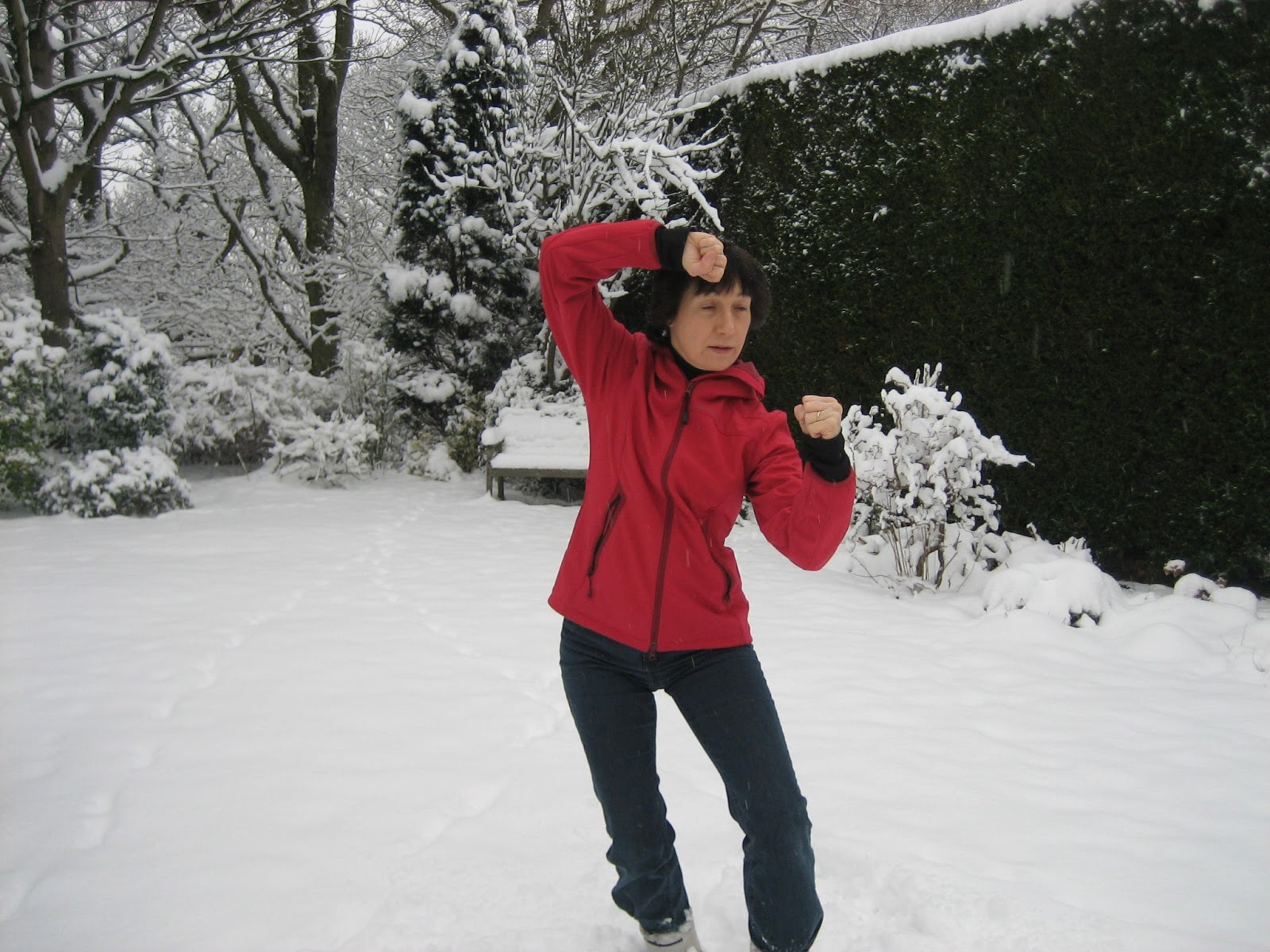
Seipai in the snow!


I don't know about you but we've had a lot of snow this last few days (about 6 inches). It has bought the usual travel chaos and school closures but it has also created a beautiful winter wonderland!

My sensei texted me this morning to say that class tonight has been cancelled because the school where we train is shut. I texted back (half jokingly, half meaning it) that we should do training in the snow. He replied that he thought that was a cool idea and he was up for it. So I sent him a challenge that I would practice Seipai outside in my back garden if he would do something too. He texted back that he was going to do some kobudo practice outside.

Well you can't renege on a challenge with your sensei can you?

So I put my coat on and some boots and went into my back garden to practice Seipai. My son took these photos of me:


Hope the neighbours weren't watching!

It's a lot harder doing kata in boots in several inches of snow and outdoor clothes make it difficult to be snappy with your moves. However, it was very invigorating and enjoyable out in the fresh air. I went through the kata about 6 times which got me pretty warmed up despite the 0 degrees temperature today! 

I think I should do this more often, it adds a new dimension to training. 

And just to show that my sensei kept his half of the bargain (though I expect he was planning to train outside all along anyway, he's pretty hardcore) here's the photo he sent me:


Okay, now I'm challenging you to train outside in the snow and post the evidence! 

Bookmark and Share
Creative Commons License
This work is licensed under a Creative Commons Attribution-Noncommercial-Share Alike 2.0 UK: England & Wales License.

Tuesday, 15 January 2013

When is a dojo not a dojo?


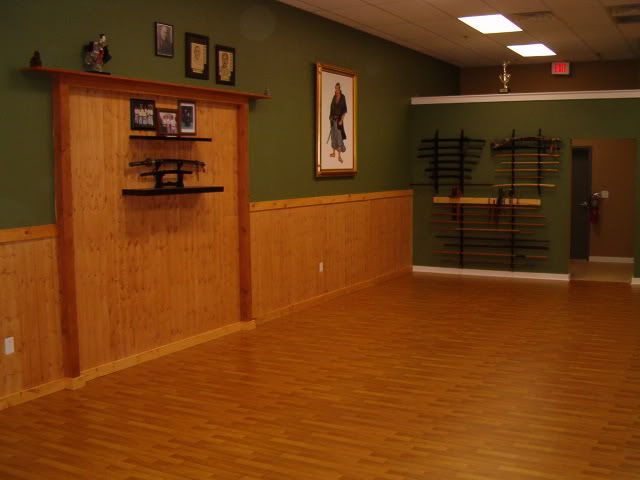
Traditional dojo environment

……when it’s a club.

I used to think that a dojo was simply the place where you did your training, whether that is a dedicated traditional dojo, a school gym, purpose built training centre or your own basement or garage. However, it seems that a dojo is much more than just the place you train.

In Michael Clarke’s book, ‘Shin Gi Tai’ ,he makes a definite distinction between a karate dojo and a karate club. He describes a club as a commercially based entity in which students pay fees and in return receive instruction in karate to a single set syllabus from which they can be awarded ascending ranks in the shape of coloured belts as they rise up the system. They can also participate in sport karate, enter competitions and collect trophies. A club may be affiliated to a higher organisation which may be the only place where a student’s black belt is recognized.

On the other hand Michael Clarke describes a dojo as a place where you learn budo.  He states that the main way in which a dojo is distinctive from a club has...

”little to do with the architecture of the place or the way people dress for training; the distinction has everything to do with the nature of the struggle going on inside each individual.”

Budo karate involves training body, mind and spirit. It is more than just learning to do karate techniques (however well you learn to do them). It is much more about learning to understand yourself.  In Michael Clarke’s words…”Without a spirited assault on your ego, the true value of karate will remain forever beyond your reach”. A “spirited assault” involves a lot of hard, physical training, self examination and reflection as well as personal reading and research.

Budo karate is individual karate, even if done in a group. Students, who will most likely have been handpicked by the Sensei based on their suitability for budo training, will not necessarily all follow the same training programme. Training will be tailored to their individual requirements and suitability (as determined by the Sensei, not the student). This is not possible with large classes of students so karate dojo typically have only a few students. 

Another main difference is that in a dojo the student is expected to take full responsibility for their own training. By that I mean they have the responsibility to turn up on time, observe the etiquette required of them, train hard, do their own research etc. The onus is on them to make progress. Any student not doing this will be asked to leave.  It would be rare for a ‘club’ student to be asked to leave for not trying hard enough or because they fail to make progress or show any understanding of what they are doing – providing they keep paying their fees.

By the criteria described above it is clear that I belong to a karate club not a dojo. Is that a problem? Is it still possible to practice budo karate in a club environment?

It would be wrong to automatically assume that all dojos are somehow superior to all clubs. There will be good and bad dojos and good and bad clubs and it will be better to be in a good club than a bad dojo. According to Michael Clarke even Okinawa has ‘bad’ dojos set up to exploit Westerners searching for the authentic karate experience.  Getting good advice about where to go is essential to avoid this pitfall if you’re planning a trip there.

A good instructor in a karate club will take an individual interest in your training and progress if you show yourself to be keen and hard working.  This will be subtle rather than overt: a willingness to chat with you after class, lending you a book or DVD, encouraging you to attend special seminars or classes, asking you for help with teaching or a grading session (this shows he/she trusts you). A positive and close relationship can develop between student and sensei in just the same way that it does in a traditional karate dojo – if you are a committed student.

I also think that it is possible to practice budo karate even if you are in a large commercial club – as long as you know what the practice of budo really entails and are prepared to tread this path alone. After all the practice of budo is an individual and lonely path by definition so it shouldn’t matter too much what environment you train in. Most good clubs will provide hard physical training and good instructors will drive you to do your best but it’s up to you whether you do so.

Every dojo will have good students (they would be asked to leave if they weren’t good) but clubs have to cope with good and not so good students (this is actually an advantage of clubs – they are inclusive and often see ‘poor’ students evolve and mature into ‘good’ students given enough time and encouragement).  I see no reason why a dedicated student in a club environment can’t achieve the same level of skill, understanding and knowledge about karate (and themselves) as a student fortunate enough to belong to one of the rare dojos dotted around the world.  The path may be less clear and contain more obstacles to circumnavigate and the student may have to look further and wider than their own club for guidance but for a dedicated student this is not an impossibility.

Club or dojo? How much does it really matter for the committed student of budo karate?


Bookmark and Share
Creative Commons License
This work is licensed under a Creative Commons Attribution-Noncommercial-Share Alike 2.0 UK: England & Wales License.

LinkWithin

Related Posts with Thumbnails