Showing posts with label traditions. Show all posts

Friday, 4 October 2013

Martial Art or Self-Defence?


Is there a difference between learning a martial art and learning self-defence?

No! You all cry, by learning a martial art you are learning self-defence, they are (or should be) the same thing.

But are they, really?

I don’t think they are the same thing, not exactly; they are overlapping but serve slightly different purposes. Let me explain….

I think that the difference between learning a martial art and learning self-defence is a difference in purpose, focus and mindset.

Learning karate as a martial art is about preservation of the art for future generations. The purpose is one of ensuring all aspects of the system are conserved and passed on in their entirety to the student, warts and all. The focus is on the art, not the student. The mindset is to explore the secrets of the kata. Exploration of kata will reveal many techniques that have no place in the modern world of self-defence, techniques that are illegal and excessive and would have you in the dock if you were to use them to defend yourself, such as neck breaks.

One hundred and fifty years or so ago in Okinawa the death of an opponent during a confrontation did not necessarily result in imprisonment. The karate master Chotoku Kyan was said to have caused the death of a rival, Chokuho Agena, following a disagreement, by jumping onto him from a tree and breaking his neck.* Today this would be classed as murder but back then this just resulted in a feud between their families that lasted for years.

Social, legal and political systems have changed over the years but a martial art remains pretty much the same – a snapshot of an older time, preserved for historical reference. The kata are like historical documents, revealing the fighting techniques of a previous age. It takes many, many years to learn a martial art.

I am making it sound as if martial arts are irrelevant to a modern age of self-defence. Of course they are not. There is much in these ancient fighting systems that are still relevant to us – the skill is in picking out these techniques and strategies and re-packaging them for today’s students.

This brings me to self-defence. Where the purpose of learning a martial art is about preservation of the art, the purpose of learning self-defence is about preservation of the individual, i.e. teaching students how to defend themselves. The mindset is different. The instructor’s role is now about selecting appropriate techniques from the repository of ancient ones that are suitable for the type of students he/she is teaching. The focus is on the student, not the art.

This is the basis of good Reality Based Self-Defence systems (RBSD) and short self-defence courses aimed at particular groups of people such as women or University students. With RBSD the instructor will have developed his system by selecting a subset of techniques probably from a range of different martial arts and re-packaging them. He will have selected techniques based on what he thinks works best from his own experience or the experience of others and with a knowledge of how violence plays out in the real world and the risks his client group face. I doubt the students would be taught how to snap someone’s neck. The result should be that the students learn to defend themselves adequately in a relatively short period of time.

However, these RBSD systems have their limitations. They will contain instructor bias – the instructor will have chosen only those techniques which he feels are appropriate and will ignore those he doesn’t like. We all have different preferences and thus each RBSD system will be a slightly different microcosm of martial arts based self-defence centred on the instructor’s world view. Techniques that may suit some student’s better will have been lost or ignored and some student’s may find that they trail from one school to another trying to find something suitable.

Going back to martial arts systems, the problem for the student looking to learn self-defence is the opposite. They are being taught everything - relevant and irrelevant for a modern world, often spending lots of time analysing kata moves that reveal only past fighting glories and could not be used today. Amongst this are the highly useful and relevant techniques. Students are often left to pick their own way through this plethora of kata moves, identifying what is useful and legal and what should be consigned to history.

So, is it possible to become proficient at personal self-defence when you are in the environment of learning a martial art?

Well, yes but it relies on two things: a willingness of the student to study and learn about the nature of violence, the law as it relates to self-defence and to think intelligently about the aspects of the art that are relevant to them personally for their own self-protection. Secondly, an instructor who is clear in his/her own mind when he/she is teaching the ancient art (focus on art) and when he/she is teaching relevant self-defence (focus on student). This may prove a longer and more tortuous way of learning self-defence but the student may learn many other useful things along the way which relate to personal development of a more ethereal nature (mind/body unity, character development, a sense of spirituality and controlling one’s own mind and body better). These are things that won’t be learnt in the more pragmatic environment of a RBSD system.

I think it is important that we continue to have clubs that focus on teaching martial arts as art, to preserve the ancient fighting systems in their entirety and to further the historical research into the meaning of the kata. This is as much an intellectual pursuit as a practical one and suits many people.

However, some people have a real need to learn self-defence, either because of personal risky lifestyles or because they work in an environment where they may need to confront an aggressor such as in the police force, prison services or the military. These people may need more targeted training than a martial art can offer and are probably better off accessing a RBSD club or a targeted self-defence course.


These are my personal views; I think that martial art and self-defence are not entirely interchangeable. What do you think and why? 

* ref: Okinawa No Bushi No Te by Ronald L. Lindsey. Page 79.

Bookmark and Share
Creative Commons License
This work is licensed under a Creative Commons Attribution-Noncommercial-Share Alike 2.0 UK: England & Wales License.

Wednesday, 3 April 2013

Why do we.........observe reishiki?


In general terms reishiki refers to the demonstration of good etiquette or ‘correct behaviours’ in a traditional martial art dojo or club. This can be anything from knowing the correct way to enter or leave the training area, how to address your sensei, knowing where and how to stand in line, to showing good manners and respect to your fellow students. Each club will have its own variation on reishiki but at the heart of all reishiki is the concept of respect (for your club, for your sensei and for each other).

In more specific terms reishiki refers to the opening and closing ceremonies that most traditional martial art clubs observe and this is the definition of reishiki that I want to discuss in this post. The word reishiki is made up of rei (bow or respect) and shiki (ceremony) and is all about setting the right tone for the class and preparing the students mentally for the training ahead. I have been involved in seminars or classes where reishiki has consisted of nothing more than a quick standing bow to sensei at the beginning and ending of class to a rather elaborate and prolonged standing , walking, kneeling, presenting the sword, bowing, more standing, walking backwards, more kneeling, bowing, standing etc. etc .etc - like a rather complicated and precisely executed kata. I had the feeling my head would be cut off if I got it wrong!

These, of course, are two extremes of the bowing ceremony.  A ceremony that is too short does not adequately prepare the students mentally for the training to come. One that is too complicated is just unnecessary and time consuming (in my opinion).

So, what should a reishiki ceremony help the student to achieve?

When we enter a dojo or training hall we are entering a world that is different to the one outside. Our roles and responsibilities inside the dojo are often very different to the ones we have outside. You may be very senior in your career and be in charge of many staff but in the dojo you may be the new white belt. On the other hand you may be an unskilled manual worker outside but a senior black belt inside the dojo. It is important to be able to leave your external roles and responsibilities outside the dojo and assume your ‘internal’ ones. A reishiki ceremony is one way of helping you to make this separation of external and internal roles. The wearing of a gi is another.

Participating in a martial art requires us to learn about and practice violence towards other human beings. Though the mindset of the martial artist should be purely about defending oneself, the techniques often needed to do that are inherently dangerous and violent. It is imperative that training is done is a controlled and mutually respectful environment that is free from ego and machismo. Reishiki helps to create this respectful environment.

When practising a martial art we are benefiting from the skill and teachings of our martial arts forebears, people who devoted most of their time to developing and perfecting techniques and encoding them in ways that we can remember today. Reishiki is a way in which we remember and honour the founders of our system and also honour the sensei that teaches us that system today.

How does reishiki achieve these things?

A typical reishiki ceremony:

Sensei gives the following commands:

1.       Seiretsu. The students are called to line up in grade order. This is the time when you have to address your position in the dojo and let go of external roles which become unimportant in this context.

2.       Seiza.  The students sit in a formal kneeling position. In some clubs the students may be sitting opposite the shomen or shinzen (shrine). In clubs that meet in a school gym or other temporary ‘dojo’ the students may face a symbolic shomen i.e. face a direction that sensei points to. Other clubs may miss this stage out altogether and just face sensei.

3.       Mokuso. The students close their eyes and observe a few moments of meditation. The idea of this is to let the students clear their minds of distracting (outside) thoughts and prepare for the training ahead.  See ‘Why do we…….perform mokuso’

4.       Mokuso yame. The students stop meditating and open their eyes.

The senior student (or a student chosen by sensei) will then give the commands:

a.       Shomen ni rei. The students bow to the shomen in order to remember and show respect to their founder.  In clubs where there is no longer any connection or communication with their Japanese origins this step may be omitted altogether.

b.      Sensei ni rei.  The students bow to sensei to show their respect to him/her and show that they are ready to listen and learn.

c.       Otaga ni rei. The students and sensei bow to each other in a mutual display of respect and courtesy. Remember, in martial arts bowing is about showing respect not subservience.

At this point the students may say words such as onegaishimasu or osu (note that osu is a contraction of the word onegaishimasu). This basically means "please let me train with you." It's an entreaty often used in asking the other person to teach you, and that you are ready to accept the other person's teaching.

Sensei then gives the following commands:

5.       Kiritsu. The students stand up with feet together and arms by their side.

6.       Rei. The students perform a small standing bow to end the ceremony.

The whole ceremony is then repeated at the end of the lesson with the gesture Arigatou gazaimashita which means thank you.

Though each class begins and ends with reishiki it must be remembered that good manners, courtesy and respect must permeate throughout the class. This keeps the class civilised, controlled and safe at all times and keeps big egos in check.

Do you have any particular reishiki rules or behaviours to share?


Bookmark and Share

Creative Commons License
This work is licensed under a Creative Commons Attribution-Noncommercial-Share Alike 2.0 UK: England & Wales License.

Tuesday, 15 January 2013

When is a dojo not a dojo?


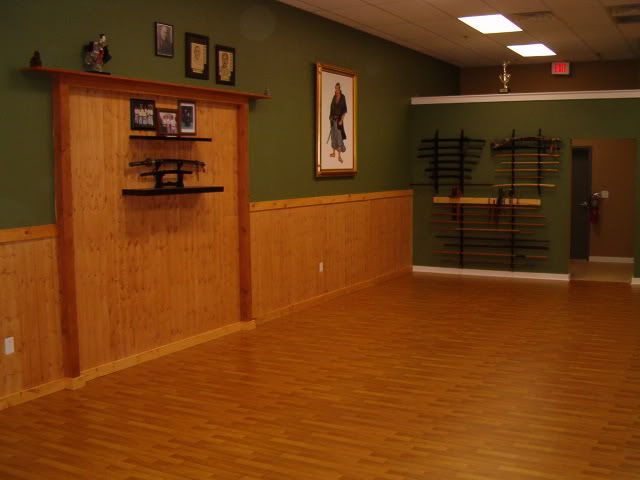
Traditional dojo environment

……when it’s a club.

I used to think that a dojo was simply the place where you did your training, whether that is a dedicated traditional dojo, a school gym, purpose built training centre or your own basement or garage. However, it seems that a dojo is much more than just the place you train.

In Michael Clarke’s book, ‘Shin Gi Tai’ ,he makes a definite distinction between a karate dojo and a karate club. He describes a club as a commercially based entity in which students pay fees and in return receive instruction in karate to a single set syllabus from which they can be awarded ascending ranks in the shape of coloured belts as they rise up the system. They can also participate in sport karate, enter competitions and collect trophies. A club may be affiliated to a higher organisation which may be the only place where a student’s black belt is recognized.

On the other hand Michael Clarke describes a dojo as a place where you learn budo.  He states that the main way in which a dojo is distinctive from a club has...

”little to do with the architecture of the place or the way people dress for training; the distinction has everything to do with the nature of the struggle going on inside each individual.”

Budo karate involves training body, mind and spirit. It is more than just learning to do karate techniques (however well you learn to do them). It is much more about learning to understand yourself.  In Michael Clarke’s words…”Without a spirited assault on your ego, the true value of karate will remain forever beyond your reach”. A “spirited assault” involves a lot of hard, physical training, self examination and reflection as well as personal reading and research.

Budo karate is individual karate, even if done in a group. Students, who will most likely have been handpicked by the Sensei based on their suitability for budo training, will not necessarily all follow the same training programme. Training will be tailored to their individual requirements and suitability (as determined by the Sensei, not the student). This is not possible with large classes of students so karate dojo typically have only a few students. 

Another main difference is that in a dojo the student is expected to take full responsibility for their own training. By that I mean they have the responsibility to turn up on time, observe the etiquette required of them, train hard, do their own research etc. The onus is on them to make progress. Any student not doing this will be asked to leave.  It would be rare for a ‘club’ student to be asked to leave for not trying hard enough or because they fail to make progress or show any understanding of what they are doing – providing they keep paying their fees.

By the criteria described above it is clear that I belong to a karate club not a dojo. Is that a problem? Is it still possible to practice budo karate in a club environment?

It would be wrong to automatically assume that all dojos are somehow superior to all clubs. There will be good and bad dojos and good and bad clubs and it will be better to be in a good club than a bad dojo. According to Michael Clarke even Okinawa has ‘bad’ dojos set up to exploit Westerners searching for the authentic karate experience.  Getting good advice about where to go is essential to avoid this pitfall if you’re planning a trip there.

A good instructor in a karate club will take an individual interest in your training and progress if you show yourself to be keen and hard working.  This will be subtle rather than overt: a willingness to chat with you after class, lending you a book or DVD, encouraging you to attend special seminars or classes, asking you for help with teaching or a grading session (this shows he/she trusts you). A positive and close relationship can develop between student and sensei in just the same way that it does in a traditional karate dojo – if you are a committed student.

I also think that it is possible to practice budo karate even if you are in a large commercial club – as long as you know what the practice of budo really entails and are prepared to tread this path alone. After all the practice of budo is an individual and lonely path by definition so it shouldn’t matter too much what environment you train in. Most good clubs will provide hard physical training and good instructors will drive you to do your best but it’s up to you whether you do so.

Every dojo will have good students (they would be asked to leave if they weren’t good) but clubs have to cope with good and not so good students (this is actually an advantage of clubs – they are inclusive and often see ‘poor’ students evolve and mature into ‘good’ students given enough time and encouragement).  I see no reason why a dedicated student in a club environment can’t achieve the same level of skill, understanding and knowledge about karate (and themselves) as a student fortunate enough to belong to one of the rare dojos dotted around the world.  The path may be less clear and contain more obstacles to circumnavigate and the student may have to look further and wider than their own club for guidance but for a dedicated student this is not an impossibility.

Club or dojo? How much does it really matter for the committed student of budo karate?


Bookmark and Share
Creative Commons License
This work is licensed under a Creative Commons Attribution-Noncommercial-Share Alike 2.0 UK: England & Wales License.
Tuesday, 26 April 2011

Happiness is.....being a modern day Samurai.

In the Times supplement last Saturday there was an article called ‘The nine secrets of contentment’. The article was essentially about those aspects of living that makes us truly happy. I have been struck at the similarities between ‘The nine secrets of contentment’ and the ‘Seven virtues of Bushido’– a Samurai moral code. I’m rapidly coming to the conclusion that the Samurai must have been a happy contented bunch of guys! Let me explain….

The nine secrets of contentment that psychologists have recently identified are: having a social life, altruism, having a belief system, having a goal or ambition, moderate wealth, listening to music, planning a holiday, being totally absorbed in a hobby and sex. The seven virtues of bushido are: rectitude, courage, benevolence, respect, honesty, honour and loyalty. Associated virtues are filial piety and wisdom. Let’s dig a bit deeper to see how they match up…

A definition of happiness: a state of well-being and contentment and a pleasurable or satisfying experience.

There are many other personal definitions of happiness that have been quoted by various people but what they all have in common is the need for personal action to bring about happiness and the requirement to act in a virtuous way. According to Aristotle happiness is, "the virtuous activity of the soul in accordance with reason": In other words happiness is the practice of virtue.

This brings us back to the Samurai who very much led their lives according to the seven virtues listed above. So, looking at the nine modern secrets of contentment let’s see which virtues are required to bring them about:

1. Social life. To have a social life we need friends. According to research, the more close friends we have, the more stable our happiness. Ten close friends are an optimal number. The definition of a friend is: A person whom one knows, likes, and trusts and is regarded with affection and loyalty. To keep good friends one has to be a good friend. This requires you to show them respect, loyalty and honesty – all Samurai virtues.

2. Altruism. This is about doing good deeds and having unselfish concern for the welfare of others. Research shows that we receive a deeper and longer lasting feeling of happiness when we do good deeds for others compared with getting a quick blast of pleasure e.g. taking part in a fun activity. Altruism requires benevolence (charitable kindness), respect (consideration for others), possibly courage (e.g. work of the voluntary lifeboat men and women) and honour (carrying out the commitments you’ve made to help someone)

3. Belief system. Research has shown that having an internal belief system had a positive impact on happiness. This didn’t have to be a religious belief system necessarily. A strong belief in your work, a hobby, a cause, family and home or a creative outlet had a similar impact on happiness to a religious belief system. It’s about believing in something bigger than yourself. Depending on what your belief is then any or all of the bushido virtues may be required to follow it.

4. Goals and ambitions: research suggests that having specific goals can contribute to happiness and if those goals are altruistic they also contribute to good health in old age. Apparently, what is most important is the journey you go on to reach the goal rather than the end point of achieving it. On the journey you may make new friendships, learn new skills and overcome fears and barriers. These achievements may be more rewarding than achieving the goal itself. Working towards goals in a purposeful and rewarding way which requires the application of many virtues e.g. rectitude (honesty, integrity and morality), courage (to move out our comfort zone), loyalty and respect (to people that help us on the journey), honesty and wisdom.

5. Moderate wealth. Apparently the optimum salary most likely to contribute to a person’s happiness is £45,000 ($75,000). Beyond this emotional happiness does not improve. What’s the point in pursuing ever more money and material wealth if it doesn’t make you happy? It’s just time wasted that could be spent pursuing activities that do lead to happiness, perhaps more altruistic ones? Many a rich person has discovered that the path to happiness is through philanthropy (and therefore benevolence) rather than selfish greed. Frugality and self-sacrifice were the order of the day for Samurai.

6. Listening to music. It is thought that music taps into parts of the brain that produce feelings of euphoria. Even sad music can be cathartic. In fact, people are generally happier when their lives include a degree of culture such as music, works of art or performance, aesthetics etc. These things add to the quality of life experiences. The Samurai knew this only too well and pursued excellence in many arts such as flower arranging, calligraphy, Noh theatre and the tea ceremony. Art provided peace and respite from war.

7. Planning a holiday. The important thing about this is the planning rather than the taking of the holiday that makes us happy. Apparently we are happiest in the 8 weeks before the holiday starts. Clearly our anticipation of having a good time is better than the reality! What is important about this is that planning a holiday represents respite from work – it is part of achieving a good work/life balance. I’m pretty sure that Samurai didn’t plan holidays or think about work/life balance but they did need to achieve a life/death balance – balance the perils of war with activities of peace and calm, hence their dedication to art and recreation.

8. Being totally absorbed in a hobby. Psychologists describe the happiness derived from being totally absorbed in a hobby as a ‘flow state’. Martial artists recognise it as ‘mushin’. In this state you don’t notice time passing and the ego falls away, freeing you of all thoughts of daily problems and preoccupations. The Samurai would have achieved a state of mushin both in battle and in recreation as they pursued their artistic endeavours.

9. Sex. Sex enters strongly and positively in happiness equations. Sex within a loving relationship is most strongly equated with happiness and wellbeing so the virtue of loyalty (as in faithfulness and fidelity) is highly important in sexual relationships.

To be a Samurai was to be virtuous. A Samurai had the discipline to meditate, practice the arts, and live a life of humility and service to fit the demands of a daimyo’s life. To be calm in the heat of battle and to achieve excellence in the arts were the requirements of the day. All this was at the heart of Zen.

If, as Aristotle suggested, happiness is the practice of virtue, then the Samurai must have been happy with their lives. Certainly carrying the burdens of guilt, deceit or total selfishness on our consciences will not lead to happiness.

Perhaps living the life of a modern Samurai or ‘warrior’ is a good thing – a path to happiness.

Are you happy? Are you virtuous?
Bookmark and Share
Creative Commons License
This work is licensed under a Creative Commons Attribution-Noncommercial-Share Alike 2.0 UK: England & Wales License.

Friday, 19 February 2010

Seishin-do


Last Autumn my karate instructor helped to found a new karate organisation called Seishin-do shukokai karate (SSK). Since then I haven’t really thought too much about what the word Seishin-do actually means. According to the SSK’s website it is defined as ‘The way of positive spirit’ but there is no explanation of what is meant by this. So, I’ve had a search round to see if I can find out a bit more:


It seems that ‘seishindo’ is a widely used term in martial arts and has several slightly different interpretations of its meaning. It seems a popular term to use in aikido circles where it is interpreted as the ‘Way of water’ or the ‘Way of the mountain stream’.

According to seishindo.com (an aikido website) :
“Seishin conveys the image of pure, clear water running down a mountain. Seishindo Aikido implies that in our practice of Aikido we follow the movement of the mountain stream, The Water Way. In our joining with this stream, we come to know the nature of water and learn from it the art of Aikido.
It is the nature of water that it will assume the shape of whatever form it encounters while remaining forever formless in itself. Water is the epitome of non-resistance. In its coursing flow it will bend and adapt to whatever it encounters. Thus by following the natural order, water overcomes that which would oppose its natural flow. “
Several martial arts have incorporated the term seishin-do into their titles including seishindo kenpo, a comprehensive American martial art based on Chinese kenpo, grappling and empty hand techniques. It was developed by Frank Landers in the late 1970’s. The definition of seishindo used in this system is:
“(Seishin: 精神 せいしん mind; soul; heart; spirit; intention), (Do: 道 どう The Way) together translate into "Way of the Mind" which is the understanding of the conscious thought that goes into formulating an action as well as the subconscious understanding of how action can deceive us in battle. To achieve Seishindo you must find harmony between physical action, and compassion for those you face in battle. Physical fighting skill is only half of a student’s total development. Complete understanding of Concepts, Principles and Ideas of motion is the other half of a martial artist training. Without Seishindo, a student physical abilities, may become strong and powerful, but will always lack that completion needed to achieve harmony in their live.”
Another system calling itself simply Seishin-do, describes itself as a ‘modern system of self-defence’ where it encourages a ‘citizen’ mentality rather than a ‘combat’ mentality with the aim of developing “Peaceful, productive and self reliant individuals whose first responsibility is to survive.” This system defines seishindo as the ‘spiritual energy way’. They state that:
 “Rather than over emphasizing the technical, as in most modern budo, Seishindo emphasizes the “spirit” of the technique, that is the doing of the technique. The“way” of Seishindo is not mystical or esoteric. It is simply recognizing aggression and reacting appropriately on an ongoing day to day basis. Spirit comes from a Latin word meaning to breathe implying oneneeds to be alive. Seishindo, the Spiritual Energy Way refers to the natural energy we all posses and that we can cultivate that energy by increasing our mental and physical acuity through martial arts training.”

So to summarise: Seishin-do can mean “The way of positive spirit”; “The way of water” or “The way of the mountain stream” to incorporate concepts of harmony and non-resistance; “The way of the mind” uniting the conscious and subconscious mind or “The spiritual energy way” referring to the ‘natural energy’ we all posses and can cultivate through martial arts training.

Each of these martial arts systems and their definitions of seishindo emphasise the mind-body-spirit connection encompassed in all budo arts. It seems to me that seishindo is about developing and mastering our minds and bodies, maximising our energy, and showing a positive but peaceful spirit in our pursuit of self-protection in order to lead healthy, safe and productive lives.

Bookmark and Share


Creative Commons License
This work is licensed under a Creative Commons Attribution-Noncommercial-Share Alike 2.0 UK: England & Wales License.

Thursday, 21 January 2010

Why do we.........say 'Osu!'?

Do you 'Osu!' in your dojo? Generally speaking, we do not 'Osu!' in ours except for one of our experienced black belts who regularly osus! I find it quite alarming (and intriguing) to hear him shout 'Osu!' up to 10 or 15 times a session. He osus when he bows announces a kata, starts a technique or whenever the instructor asks or tells him something. I presume his use of this word is related to his karate 'upbringing' over 30 years ago.

So what is this 'Osu!' thing all about? I decided to do some research:

First, let’s just say the correct pronunciation is 'oh-sss' rather than 'oo-sss', which is a common mispronunciation in the West.

Osu is a Japanese greeting word (aisatsu). It is a contraction of other greeting words such as Ohayossu or ohayoosu, Ohayo or even just Oh. The more contracted the word the less formal the greeting. It's a bit like going from 'Good Morning', to 'Hello' to 'Hi' depending on the context and company you are in.

In general parlance in Japan 'Osu' is a very 'rough' male greeting between friends in an athletic setting. It is a very male word - an expression of masculinity, something men may greet each other with in a football or baseball club. It is generally only used by children and 'macho' or rough men! In Japan, a woman would never use such an impolite word and a man would be considered rude to use it to greet a woman.

So why do we use it in martial arts?

It is a word mainly used in karate clubs, though some judo and taekwondo clubs have been known to use it too (possibly because the instructor has a karate background). It is not an Okinawan word so Okinawan styles of karate generally don't use it. The origin of the word is not entirely clear but it is thought that the use of “Osu!” first appeared in the Officers Academy of the Imperial Japanese Navy, in the early 20th century and later became common with karate students. This helped establish the rough masculine nature of the word.

What is its purpose in the dojo?

In some dojo's 'osuing' is a standard part of the dojo etiquette and all students are expected to use it, whereas in other dojo's it is actively discouraged because it is not considered very polite, preferring more polite expressions such as “Onegaishimasu.”!

However, if you consider another translation of the word, which is also a contraction of the two kanji symbols used to write the term “Oshi Shinobu” it means "to persevere while pushing oneself to the absolute limit.” The strength of character that develops from hard training is known as “osu no seishin” (the spirit of “Osu!”). It implies a willingness to push oneself to the limits of endurance, to persevere under any kind of pressure. This is the context in which it is being used in the dojo.

The word 'Osu!' has many purposes in the dojo. It can be used to greet fellow students instead of saying hello (at least among the men); to respond to a question or instruction instead of saying yes; if your instructor thinks you are weak or injured you can reply 'osu' to reaffirm that despite your weakness/injury you are willing to still try your best; you can say it to remind yourself that despite the pain you need to carry on i.e. show your 'warrior spirit' or you can use it to acknowledge your opponents skill at a technique or in a tournament. It seems like a very flexible and versatile word!

And finally! Some general 'Osu!' etiquette:

  • "Osu!" is primarily a greeting.
  • You use it toward other people, not toward an empty room when you bow onto the mat or before you perform a kata.
  • You cannot really use it for "goodbye."
  • It is never a question and does not mean "I understand."
So do you 'Osu!' in your dojo?

Click here if you want to read a comprehensive article on the use of 'Osu'.


Bookmark and Share

Creative Commons License
This work is licensed under a Creative Commons Attribution-Noncommercial-Share Alike 2.0 UK: England & Wales License.

Wednesday, 30 December 2009

Why do we.........do Shikko?

Shikko, or knee walking (also known as samurai walking) is not something that we do in karate but it is an important element in aikido and in Japanese sword training. However, my karate instructor is also a keen student of aikido and so decided to introduce us to a bit of knee walking. This rather strange way of moving across the floor intrigued me so I decided to find out a bit more about its history and why it is still done today.

First let's have a look at some knee walking:


Historically, knee walking has been done in Japan for centuries in both civilian and military life. In civilian life in old Japan most of the activities done inside the home or a building were done on the knees such as cooking, eating or even discussing business. In addition to this, most typical Japanese buildings were never very tall because natural resources such as wood were very scarce and costly, so standing up to perform tasks was not an option. Knee-walking became a common practice in family life.

During Feudal times, the Samurai would be expected to sit and walk around on their knees while in the presence of a daimyo (feudal lord). This was also a position in which one received guests, not all of whom were always trustworthy, so in theory, keeping everyone low to the ground made it more difficult for anyone to attack the daimyo. However, samurai still had to function as warriors and bodyguards and so trained to fight, if necessary, from the iaigoshi position. Iaigoshi is similar to the seiza (kneeling) position but the balls of the feet remain on the ground so that you are always in a position to move quickly, either by walking on the knees or by leaping to the feet.

It is fairly easy to see why, in the art of the Japanese sword, shikko is still practised along with learning sword techniques from the iaigoshi position. These traditional samurai techniques are integral to the art. However, why is shikko practised so widely in aikido, which is a modern budo art?

Aikido is a blend of (mainly) grappling arts (
Daitō-ryū aiki-jūjutsu, Tenjin Shin'yō-ryū Gotōha Yagyū Shingan-ryū and judo) Though Daitō-ryū is the primary technical influence on aikido, it also derives much of its technical structure from the art of swordsmanship (kenjutsu). Many of the strikes of aikido are often said to resemble cuts from a sword or other grasped object, which indicates its origins in techniques intended for armed combat. Other techniques, which appear to explicitly be punches are also practiced as thrusts with a knife or sword.

This influence of the sword in aikido extends to learning techniques from the iaigoshi or seiza position (suwari waza - both uke and nage seated; hanmi handachi - uke standing, nage seated) in much the same way as it is practised in kenjutsu and thus the need to learn shikko becomes more apparent.

Training to do shikko has many positive physical benefits. It increases strength and flexibility in the legs and hips. The rotational movement required to walk in shikko is particularly good for getting one used to engaging the hips properly when moving and is very important for developing a strong awareness of one's center of gravity (hara or lower dantian).

So how do you do it?

1. From iaigoshi position: drop the right knee to the floor
2. without raising the hips, step forward to assume a left-leg leading iaigoshi.
3. repeat the movement to continue moving forward in a straight line.
While moving in shikko, keep the balls of the feet in a straight line and avoid raising and lowering the body. Ref: Bokken - art of the Japanese Sword, p.58, by David Lowry.

Here's another description of how to knee walk from David Harvey: http://www.gedanate.com/martialarts/japanese/aikido/shikko-knee-walking/
"Imagine your ankles are tied together with a set of elastic bungee
cords…
You are kneeling. Then you lift up your right knee and place the right
foot flat to the floor.
The imaginary ‘elastic’ pulls both your heels together, so your left heel swivels across to touch your right heel. The heels are together again.
Using your hip, and leaving your feet where they are, allow your right knee to kneel down again. You have just moved forward about 19 inches (50 cms).
Now raise the left knee and bring the left leg forward so the foot is flat on the ground and the left knee is raised. (Your ankles are apart again, so imagine that elastic pulling them together again.)
Swivel your right ankle now so it meets the left ankle again.
This is basic Shikko knee walking, the Samurai Walk."


To finish - a look at the application of shikko in suwari waza (the overhead filming of suwari waza randori is particularly impressive at the beginning of this video)


Sources:
http://www.aikido-world.com/highlights/technical%20_tips/samurai-walk.htm
http://en.wikipedia.org/wiki/Shikko#Shikk.C5.8D
http://www.gedanate.com/martialarts/japanese/aikido/shikko-knee-walking/
Bokken - Art of the Japanese Sword (1986). David Lowry. Black Belt Books.

Bookmark and Share


Creative Commons License
This work is licensed under a
Creative Commons Attribution-Noncommercial-Share Alike 2.0 UK: England & Wales License.

LinkWithin

Related Posts with Thumbnails