Monday, 21 January 2013

Seipai in the snow!


I don't know about you but we've had a lot of snow this last few days (about 6 inches). It has bought the usual travel chaos and school closures but it has also created a beautiful winter wonderland!

My sensei texted me this morning to say that class tonight has been cancelled because the school where we train is shut. I texted back (half jokingly, half meaning it) that we should do training in the snow. He replied that he thought that was a cool idea and he was up for it. So I sent him a challenge that I would practice Seipai outside in my back garden if he would do something too. He texted back that he was going to do some kobudo practice outside.

Well you can't renege on a challenge with your sensei can you?

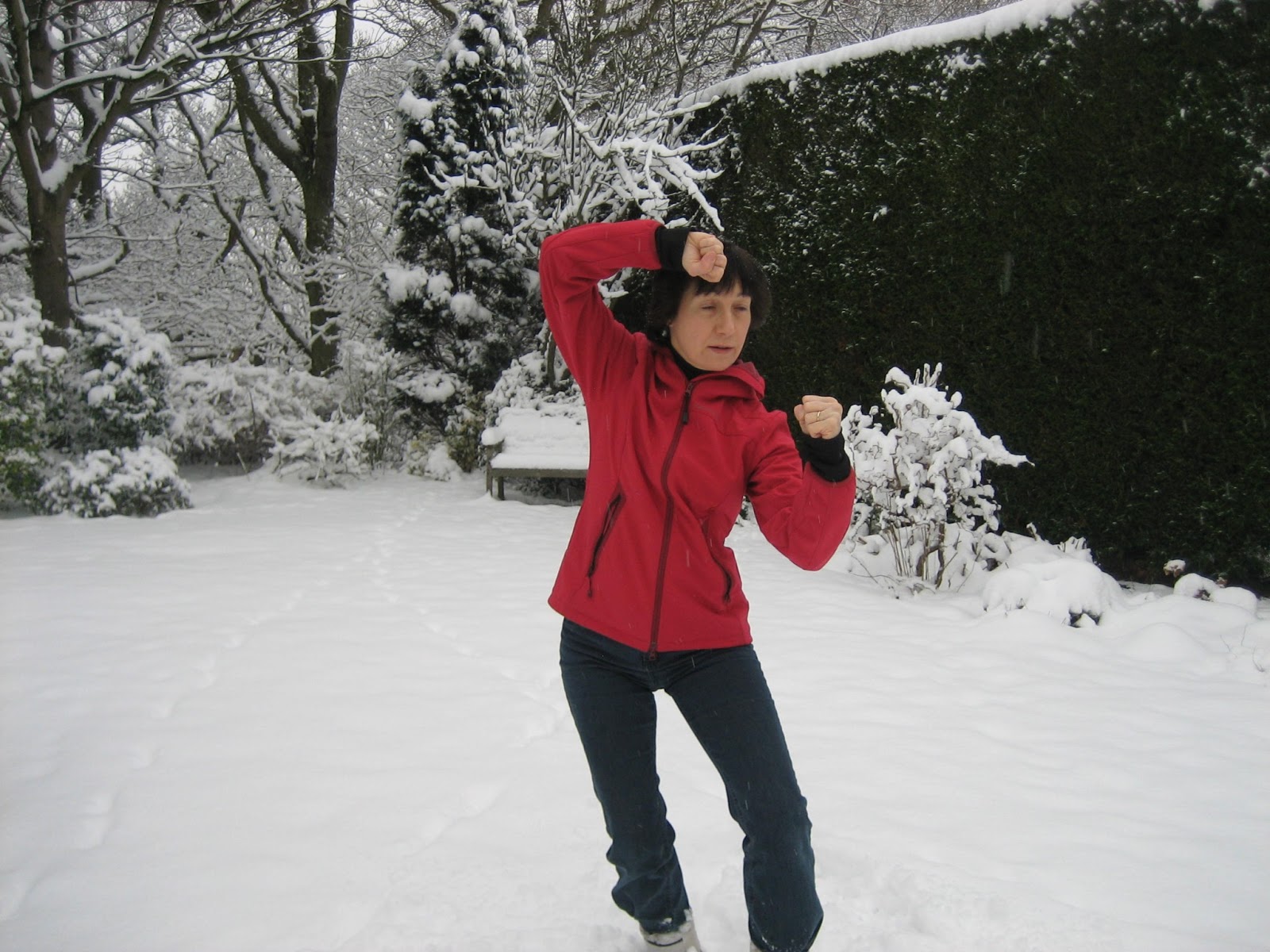
So I put my coat on and some boots and went into my back garden to practice Seipai. My son took these photos of me:


Hope the neighbours weren't watching!

It's a lot harder doing kata in boots in several inches of snow and outdoor clothes make it difficult to be snappy with your moves. However, it was very invigorating and enjoyable out in the fresh air. I went through the kata about 6 times which got me pretty warmed up despite the 0 degrees temperature today! 

I think I should do this more often, it adds a new dimension to training. 

And just to show that my sensei kept his half of the bargain (though I expect he was planning to train outside all along anyway, he's pretty hardcore) here's the photo he sent me:


Okay, now I'm challenging you to train outside in the snow and post the evidence! 

Bookmark and Share
Creative Commons License
This work is licensed under a Creative Commons Attribution-Noncommercial-Share Alike 2.0 UK: England & Wales License.

Tuesday, 15 January 2013

When is a dojo not a dojo?


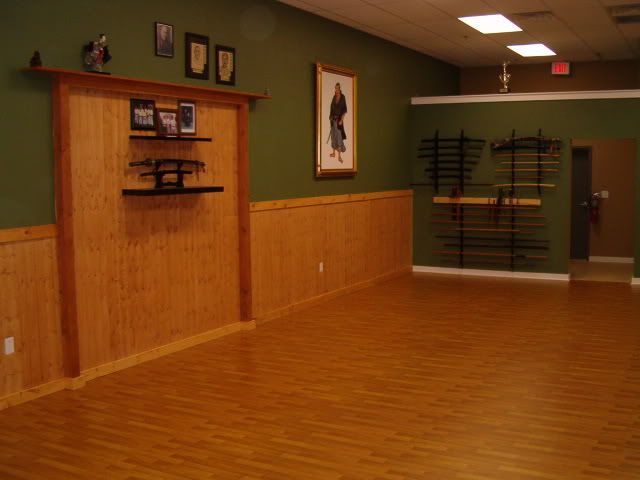
Traditional dojo environment

……when it’s a club.

I used to think that a dojo was simply the place where you did your training, whether that is a dedicated traditional dojo, a school gym, purpose built training centre or your own basement or garage. However, it seems that a dojo is much more than just the place you train.

In Michael Clarke’s book, ‘Shin Gi Tai’ ,he makes a definite distinction between a karate dojo and a karate club. He describes a club as a commercially based entity in which students pay fees and in return receive instruction in karate to a single set syllabus from which they can be awarded ascending ranks in the shape of coloured belts as they rise up the system. They can also participate in sport karate, enter competitions and collect trophies. A club may be affiliated to a higher organisation which may be the only place where a student’s black belt is recognized.

On the other hand Michael Clarke describes a dojo as a place where you learn budo.  He states that the main way in which a dojo is distinctive from a club has...

”little to do with the architecture of the place or the way people dress for training; the distinction has everything to do with the nature of the struggle going on inside each individual.”

Budo karate involves training body, mind and spirit. It is more than just learning to do karate techniques (however well you learn to do them). It is much more about learning to understand yourself.  In Michael Clarke’s words…”Without a spirited assault on your ego, the true value of karate will remain forever beyond your reach”. A “spirited assault” involves a lot of hard, physical training, self examination and reflection as well as personal reading and research.

Budo karate is individual karate, even if done in a group. Students, who will most likely have been handpicked by the Sensei based on their suitability for budo training, will not necessarily all follow the same training programme. Training will be tailored to their individual requirements and suitability (as determined by the Sensei, not the student). This is not possible with large classes of students so karate dojo typically have only a few students. 

Another main difference is that in a dojo the student is expected to take full responsibility for their own training. By that I mean they have the responsibility to turn up on time, observe the etiquette required of them, train hard, do their own research etc. The onus is on them to make progress. Any student not doing this will be asked to leave.  It would be rare for a ‘club’ student to be asked to leave for not trying hard enough or because they fail to make progress or show any understanding of what they are doing – providing they keep paying their fees.

By the criteria described above it is clear that I belong to a karate club not a dojo. Is that a problem? Is it still possible to practice budo karate in a club environment?

It would be wrong to automatically assume that all dojos are somehow superior to all clubs. There will be good and bad dojos and good and bad clubs and it will be better to be in a good club than a bad dojo. According to Michael Clarke even Okinawa has ‘bad’ dojos set up to exploit Westerners searching for the authentic karate experience.  Getting good advice about where to go is essential to avoid this pitfall if you’re planning a trip there.

A good instructor in a karate club will take an individual interest in your training and progress if you show yourself to be keen and hard working.  This will be subtle rather than overt: a willingness to chat with you after class, lending you a book or DVD, encouraging you to attend special seminars or classes, asking you for help with teaching or a grading session (this shows he/she trusts you). A positive and close relationship can develop between student and sensei in just the same way that it does in a traditional karate dojo – if you are a committed student.

I also think that it is possible to practice budo karate even if you are in a large commercial club – as long as you know what the practice of budo really entails and are prepared to tread this path alone. After all the practice of budo is an individual and lonely path by definition so it shouldn’t matter too much what environment you train in. Most good clubs will provide hard physical training and good instructors will drive you to do your best but it’s up to you whether you do so.

Every dojo will have good students (they would be asked to leave if they weren’t good) but clubs have to cope with good and not so good students (this is actually an advantage of clubs – they are inclusive and often see ‘poor’ students evolve and mature into ‘good’ students given enough time and encouragement).  I see no reason why a dedicated student in a club environment can’t achieve the same level of skill, understanding and knowledge about karate (and themselves) as a student fortunate enough to belong to one of the rare dojos dotted around the world.  The path may be less clear and contain more obstacles to circumnavigate and the student may have to look further and wider than their own club for guidance but for a dedicated student this is not an impossibility.

Club or dojo? How much does it really matter for the committed student of budo karate?


Bookmark and Share
Creative Commons License
This work is licensed under a Creative Commons Attribution-Noncommercial-Share Alike 2.0 UK: England & Wales License.

Friday, 4 January 2013

Sport kumite – what does it teach you?


Sport kumite is a modern 20th century Japanese addition to the original Okinawan karate. For those that choose to follow a very classical budo Way of karate the sport version represents anathema to them; to others the sport version is karate. After all why learn all those techniques if you have no arena to test them in?

For me personally I tend to swing hot and cold on the validity and worthiness of doing sport kumite. I have no interest in competing and I have philosophical objections to teaching people to ‘fight’ rather than to learn to defend themselves (more on this later). However, sport kumite is a part of our syllabus and I think there are some benefits to be gained from doing it.

There are many versions of kumite in karate so I’ll just define what I mean by sport kumite: I’m talking about minimal contact point sparring with only sparring mitts and mouth guard for protection. The aim is to score points by landing a  punch or kick on one of the target areas i.e. the abdomen, head or between the shoulder blades (kicks only) whilst preventing your opponent from scoring against you. Sweeps are allowed and points can be scored by punching the opponent when on the ground.  My analysis of sport kumite refers only to this type of sparring so if you are use to a more hard core full-contact version then your list of strengths and weaknesses may be different to mine.

The problems with sport kumite:

1.       It can teach a ‘fighting’ mindset rather than a ‘self-defence’ mindset. Fighting requires two people to consent to the ‘fight’. Both are trying to ‘win’ the bout by attacking the other person. Self-defence requires a mindset that wants to avoid fighting and does only what is necessary to avoid, prevent, de-escalate, control or escape a violent situation.

2.       It can cause confusion to the student if both classical and sport kumite are being taught side by side. I found this very confusing when I was in the junior kyu grades.  Until I understood that two different types of karate were being taught I didn’t understand why in one part of the lesson I needed to keep my feet planted firmly on the floor and punch from the hip and then later on I had to be up on my toes moving around and punching quickly without pulling back to the hip first!  I cope with it now by completely compartmentalising these two different versions of karate as if they were two different arts.

3.       It does not provide an arena for testing out skills and techniques (other than sport karate skills and techniques).  It bears no resemblance to how an encounter in real life may pan out, mainly because of the rules designed to maintain the safety of the competitors which means that most of the effective techniques are taken out.

However, though I don’t feel that sport karate bears any resemblance to a real situation and has many negative aspects that doesn’t mean that there is nothing positive and useful to be learnt from it either. I’m always the optimist and generally look for positive things to take away from any aspect of my training.

The benefits of sport karate:

1.       For many people facing an opponent in a sparring bout is the first time they’ve ever been in a ‘fight’ and had to find their courage to defend themselves. Not everyone who does martial arts has a history of getting into street fights or bar brawls as a youth or has worked as a bouncer or in the security sector. Sport kumite is as close as they’ve ever been to a real fight. It can take some people a while to find their courage to spar effectively with an opponent. Finding this courage is essential if you are to have the confidence to defend yourself in a real situation one day.

2.       In sport kumite, despite the relatively safe environment and limited number of techniques in use, the fight is still unpredictable and has a random element to it. This teaches you to be very aware and focused for the whole of the fight. It teaches you to react quickly and anticipate your opponent’s next move. It teaches you to look for opportunities to strike and to recognise telegraphing by your opponent and capitalise on it. You have to keep your mind empty of extraneous distracting thoughts, stay in the moment and control your aggression so that you don’t lose control of the fight.

3.       Sport kumite also teaches you to take a punch. Even in the light weight version of kumite that we do a punch can land a bit harder than intended and wind you or land on your nose which is very painful. A kick can catch you in the ribs. When this happens you have to learn to carry on despite the pain. This comes as a shock to newcomers whose instinct is often to stop once they are hurt or stop if they have hurt their opponent. However, unless the injury is quite serious the referee won’t stop the fight so you have to learn to just carry on. You can’t afford to just stop defending yourself in a real fight when you feel pain – your attacker will just carry on.

In conclusion:

I think that when one is engaged in sport kumite it is important to recognise it for what it is – sport. A real violent encounter in the real world will not resemble a sparring round in the arena and so sport kumite cannot entirely prepare you for this event (neither can any other form of martial sport e.g. boxing, wrestling, MMA etc.). However kumite does teach some skills that are essential to good self-defence – good speed and reaction times, anticipation, focus, defending your head, carrying on after being hit etc. In fact one could question how these skills could be learnt without the random element that kumite provides. 

Never the less, sport kumite is an incomplete package, it leaves out the techniques that are essential to controlling and/or restraining an attacker – slaps, eye rakes, vital point strikes, locks, throws, joint breaks etc. It also focuses your attention on violence and attacking rather than avoidance and escape which would be the self-defence strategies of choice. 

Though sport kumite offers something useful to the martial artist it is important to be mindful of its limitations as well. What do you think about sport kumite in karate?


Bookmark and Share
Creative Commons License
This work is licensed under a Creative Commons Attribution-Noncommercial-Share Alike 2.0 UK: England & Wales License.

Saturday, 1 December 2012

Seipai - not just a Goju Ryu kata


One of my current kata is the Naha-te derived kata, Seipai. This kata is generally a staple of the Goju Ryu stylists and remains remarkably unaltered across all Gojo ryu schools. However, it is also a kata that was taught by Kenwa Mabuni in his Shito Ryu style and is still taught in many branch styles of Shito Ryu, including Shukokai. In our system of Shukokai karate this kata is first introduced once 1st dan is achieved.

There is little to found on the history and origins of this kata other than the kanji for Seipai apparently translates to the number 18 if you use the Okinawan dialect. However, the kanji for Sei can also mean 'controlling'. The kata is generally attributed to Kanryo Higaonna who is said to have brought the kata back from Fuzhou district in China. However there is no evidence to support this. It is also thought that seipai may have its origins in the Dragon style of Shaolin kung fu.

Wherever Seipai has it's origins it is typically a Naha-te style kata, with it's fairly slow tempo and rooted stances, particularly the use of sanchin dachi and shiko dachi. There are also lots of circular arm movements, again typical of the Naha-te style. This kata pairs well with Seienchin kata and anyone who has learnt both kata will notice that they have a similar 'feel' to them.

I love these Naha-te kata and wish we had more of them in our syllabus. They make a nice counter-balance to the faster, more explosive linear katas of the Shuri-te style. I actually found the embusen to Seipai difficult to learn  as there are lots of changes of direction and it can be easy to lose sight of where the 'front' is when you are first learning this kata. However, now that I've got the hang of it it is one of my favourite kata and there's some pretty interesting bunkai to learn too.

Here's a video of Seipai:


Bookmark and Share
Creative Commons License
This work is licensed under a Creative Commons Attribution-Noncommercial-Share Alike 2.0 UK: England & Wales License.

Tuesday, 13 November 2012

My top ten posts...


I wondered if you might be interested to know what my top ten blog posts of all time were?  ‘Of all time’ goes back to when this blog started in February 2009. In that time I have published 260 posts (including this one) but certain ones remain popular even though they may have been written months or even years ago.  In fact five of my all time top ten posts are still currently in my ‘this week’ top ten as well, so clearly those subjects grabbed you for some reason.  So here’s my top ten, in reverse order:


10. Martial arts – a balancing act (Published 14th Janurary 2011)

In this post I discussed my own problems with maintaining balance sometimes and looked at the physiology behind balance. I then looked at how these balance principles apply to martial arts and what you can do to improve your own balance issues. I’m still very mindful of these balance principles when I am doing karate and my balance is much improved now -always room for improvement though ;-)

9. Muscle Memory – it’s all in the mind! (Published 3rd February 2011)

This post was designed to dispel a few myths about muscle memory. I wrote about disliking the term ‘muscle memory’ preferring the more accurate term ‘motor memory’. I then tried to explain the best I could the physiology behind motor memory and how we produce motor maps in our brains that help us to unconsciously execute complex motor movements such as martial arts moves. My main point was to explain that the muscle/motor memory resides in the brain not the muscles!

8. Six things I’m looking forward to post black belt (Published 27th January 2011)

I wrote this post 6 months before I took my black belt grading as part of my black belt preparations. I was aware from other bloggers that many people suffer the ‘black belt blues’ after achieving there shodan grading and I wanted to avoid this. I felt that having some kind of plan or post black belt objectives to think about may help to prevent that ‘anti-climax’ feeling that some people get. All I can say is 17 months after achieving my black belt I have not at any time felt like giving up or felt rudderless or directionless in any way – and yes, I have been enjoying those 6 things I wrote about in this post.  A good job really because the prospect of Nidan grading is raising its head at me in 7 months time!

7. Teaching karate to young children. (Published 6th July 2010)

Wow! Has a lot of water gone under the bridge since I wrote this post. Back then I was a brown belt student helping out in class to gain teaching experience for when I could take my instructor’s certificate post black belt. I now have many hours of teaching experience with kids in after school karate clubs. I still find it rewarding and sometimes frustrating and I’m still always looking for new ideas to motivate and teach kids – it’s all definitely a challenge still!

6. How much did your black belt cost? (Published 19th April 2012 – still in this week’s top ten)

I wrote this post after reading about how some martial arts schools really exploit their students and overcharge them or tie them into extortionate contracts. I decided to work out how much it had actually cost to get from white belt to black belt in terms of class fees, licence fees, grading fees, equipment, course etc. I calculated that it had cost me £1577 over 4 years to get my black belt or £7.58 per week! I concluded that this was good value for money.

5. The black belt grading – an observer’s view. (Published 30th November 2010)

Six months before I took my own black belt grading I partnered one of our teenage girls for hers. This gave me an opportunity to have a sneak preview of what to expect for my grading – there’s always method in my madness! I wrote a report about the day which has proven to be very popular.

4. Barefoot care. (Published 21st September 2010 – still in this week’s top ten)

I wrote this foot care guide because I was getting problems with my own feet – mainly cramps, blisters and cracked skin on my the underside of my toes from friction on the hard training floor. I presume this post is so popular because it appeals to people, other than martial artists who also train barefoot or just suffer from foot problems in general. I must confess that I don’t do everything that I mention in the guide but I think my feet are a little stronger now, though I still get the occasional blister!

3. Why do we…. sit in Seiza? (Published 14th July 2009 – still in this week’s top ten)

This was one of 8 ‘Why do we……’ articles that I wrote and has proven to be the most popular. I was fascinated with the traditions and rituals that surround traditional martial arts and decided to try and research the origins and meanings of them. I still really value the opening and closing seated bow ceremonies that we practice in our club and teach it to all my children’s after school clubs.  All the kids seem to like it too.

2. Ikebana and Martial Arts – a shared philosophy. (Published 3rd December 2009 – still in this week’s top ten)

As part of my learning to understand budo I went through a phase of learning about other Japanese Ways including Ikebana (Japanese flower arranging or The Way of flowers). Reading about Ikebana I was amazed at how similar the philosophy was to that of budo and so wrote a post about the subject. It is still very popular and remains in my weekly top ten posts every week.
Okay, so now for my top post of all time. I can’t, in fact, take the credit for this post because it was actually written by several of my readers – I just edited and compiled the information you gave me – so give yourselves a bit pat on the back because you hold the number one position in my top ten posts of all time:

1. The World Guide to Passing Your Black Belt Test. (Published 16th November 2010 – still in this week’s top ten)

This guide resulted from me asking my readers for any tips they had that would help me to prepare for my black belt test. I was so overwhelmed with the response that I got that I decided to compile all the tips into a guide that others could also use giving credit (and a link) to every contributor. It has been phenomenally popular, receiving at least 1000 more hits that the number 2 post! I sincerely hope that all the contributors to this guide who received a link to their own blog/website continue to get as much traffic via this post as I receive from it.

Well that’s it; my top ten posts of all time. I hope you enjoyed reading it and a big thank you to all of you who continue to read this blog and especially those who take the time and trouble to leave me a comment.

Happy blogging!

SueC


Bookmark and Share

Creative Commons License
This work is licensed under a Creative Commons Attribution-Noncommercial-Share Alike 2.0 UK: England & Wales License.

LinkWithin

Related Posts with Thumbnails