Wednesday, 28 March 2012

A beginner's mindset....


Yesterday I read a comment left on one of my recent posts, Joint locking – how useful is it really? by an anonymous commenter, which accused me of having a ‘beginner’s mindset’. I say accused because the tone on the comment was clearly an attempt to patronise or insult me.

This is the offending part of the comment :

“…….I find this discussion rather sterile and representative of a beginner's mindset: take this question to your sensei, if he/she can't show it follow my previous advice. 

I don't mean to be condescending but from what you've written it's clear your understanding of this subject is rather limited:
 …….”

(This is just an excerpt from the comment; visit the post to read the entire comment)

At first I was a little taken back by the comment but after thinking about it for a few minutes I realised that being told I had a beginner’s mindset was in fact very high praise! It meant that I was open-minded, my cup isn’t yet full, I can still learn new things, gain new understanding….

Actually I don’t thing Anonymous meant that at all but he/she is wrong in thinking that a beginner’s mindset is a bad thing in a martial artist.

Maintaining a beginner’s mindset is a Zen concept called shoshin.  It refers to having an attitude of openness, eagerness, and lack of preconceptions when studying a subject, even when studying at an advanced level, just as a beginner in that subject would.

Zen teacher, Shunryu Suzuki said, “In the beginner's mind there are many possibilities, in the expert's mind there are few.”

There are clearly many advantages to maintaining a beginner’s mind: curiosity, openness, enthusiasm, creativity…… Unfortunately, the person with the ‘expert mind’ becomes the opposite of this: – un-inquiring, closed mined, stilted, un-creative – arrogant even.

Clearly the concept of shoshin has spread far and wide. A quick google on ‘beginner’s mindset’ found articles promoting the concept on a range of activities including swimming, software production, yoga and advertising. Each of the experts in these fields was promoting the idea of maintaining a beginner’s mindset to improve one’s ability in the respective field of practice.

All I can say to Anonymous is thank you for noticing that I have a beginner’s mindset. Clearly I am still on the right path in my martial arts studies.

Do you have a beginner’s mindset?

Bookmark and Share
Creative Commons License
This work is licensed under a Creative Commons Attribution-Noncommercial-Share Alike 2.0 UK: England & Wales License.

Friday, 23 March 2012

My Martial Art Aims for 2012...a progress report

What's your New Years Resolution?, www.GetHotIn90.com

At the beginning of the year I wrote a post outlining my Martial Arts aims for 2012. Just to show that I’m not ‘all mouth and no trousers’, as they say, and to keep me focused on achieving these aims, I thought I’d write you a progress report….


We are now a quarter of the way through 2012 so hopefully I have made some progress with my aims. Here’s a recap on what I wanted to achieve and how it’s going so far….

1.       To improve personal fitness and overcome a repetitive shoulder injury:
I had planned to produce a personal fitness programme to work on at home because this worked quite well for me when I was training for my black belt grading. However, despite buying a couple of kickboxing workout DVDs (which I thought would be a fun way of working out) I haven’t really got very far with this. I could make 101 excuses why I haven’t got a fitness programme worked out but that’s all they’ll be – excuses. Anyway, my job finishes next week and I’m going to have a lot more time on my hands so I will definitely get to grips with this aim for the next quarter of the year!

Just because I haven’t got my act together at home doesn’t mean I haven’t been working on my fitness. Oh no! Sensei seems to be on a mission to get us all fitter so we have been doing a lot of fitness drills and exercises during classes. We have a regular fitness binge at the beginning of class with push ups, sit ups, burpees, straight leg raises, squats, lunges, planks etc. So all is not lost with my personal fitness aim…..

Talking about doing push ups, they are a real problem for me at the moment because of this dratted shoulder injury. I have been receiving physiotherapy for several weeks now and things are improving, slowly but surely. Apparently, due to the initial injury (probably rotational cuff injury) I have been allowing my shoulder to roll forward to compensate and reduce the pain. This has resulted in the muscles in my shoulder blades not working properly and my right shoulder blade is misaligned and weak. I have been working on some exercises to correct this and things have improved. However, after a heavy punching or throwing session my shoulder is throbbing and the muscles leading up to my neck and down the right side of my spine are knotted and tender. Definitely a work in progress this one…

2.       To continue to develop and improve martial arts skills:
I think I have only missed one karate class and a couple of kobudo classes this year, so not a bad record. We have also had a couple of ‘higher grade’ classes for black and brown belts. About 8 – 10 of us have attended these and we have covered some pressure point techniques and some wave form striking techniques. Having covered them in some detail during these classes we are now looking at how they can be applied in bunkai. I wasn’t too keen on wave form striking the first time I met it, read this post, but now I am much more amenable to its merits and how it fits into the bigger picture.

I graded successfully last week in kobudo with the nunchuku, so now I will be back training with the bo for a few months and probably the bokken as well (I love the bokken!)

I have also attended a regional kobudo course. This was very interesting, not to mention painful! We learnt some nasty wrist and ankle throws using a sai, ouch! Did some bo fighting, great fun, and learned a battlefield signalling kata with a tessan (fan). I loved learning that kata and what all the signals meant – I’d definitely like to take up the tessen as one of my weapons.

My karate instructor also put on a kobudo seminar recently.  He went out to Okinawa last summer to train in kobudo with Hokama Sensei and is now teaching us some Okinawan bo and nuchuku kata. This was an interesting experience because the Okinawan way of teaching kobudo is very different to the Japanese way, particularly when taught in a jujitsu club – see my recent post: What exactly is kobudo?

For later in the year our club is planning its first gashaku (training camp) which should be fun. As well as karate training we will be free to take part in other pursuits available at the camp site such as archery, swimming, climbing etc. There will also be lots of socialising and BBQs so let’s hope the British weather doesn’t let us down!

3.       To improve teaching and leadership skills…
This is probably the aim that I have made most progress on so far. The sports leadership award course that I wanted to do hasn’t happened yet because there aren’t enough people in my area wanting to do it so the organisers have told me to enquire again later in the year.

However, I have done a lot of teaching – independently. I ran a 6 week after school karate class for 4-7 year olds at a local primary school which seemed to go okay. Most of the kids were great and made good progress in the time they had. One or two expressed an interest in carrying on with it so hopefully we will see them at the club. Discipline issues remained a problem with a couple of the boys and I tried various tactics to sort them out. I really need to reflect on these classes so that I can improve them for the next time we run such a course, which hopefully will be after Easter.

In fact my sensei and I went into a local primary school last Wednesday to do a karate demonstration and talk to enthuse the kids. We just need to wait and see how many are interested in coming along to an after school club now.

I also went along to my first Instructors training course in January. That was interesting experience training with all the senior instructors from our organisation – I definitely felt like the new girl! However it was a chance to learn firsthand all the changes that are happening to our syllabus which are quite exciting.

Looking back, it feels that I am fairly on track with achieving my martial arts aims for 2012. Of course there is no real endpoint to achieving these aims but I find that writing things down really helps me to stay focused and on track.

My latest venture is setting up a martial arts library for the kids in our club but more on that later…..


Bookmark and Share
Creative Commons License
This work is licensed under a Creative Commons Attribution-Noncommercial-Share Alike 2.0 UK: England & Wales License.

Wednesday, 14 March 2012

What exactly is kobudo?


Kobudo
What exactly is kobudo? I have been training in kobudo for the last two and a half years and I’m still not exactly sure what kobudo is. The basic description of kobudo that I would give to a layman would be ‘weapons training’ but that is very simplistic. After all a gun is a weapon but training to use a gun is not kobudo!

There is a distinction between the terms kobudo and Okinawan kobudo. The word ko-bu-do  breaks down to mean ‘Ancient’ (ko) ‘Stop War’, meaning ‘Peace’ (bu) and ‘Way’ (do) i.e. the ancient way of peace ( sometimes also known as ancient martial way). Some of the weapons used in Okinawan kobudo are based on ancient farming and fishing implements, such as tonfa, nunchuku and kama, whereas some were designed to be weapons such as the sai which was used by the domestic police for crowd control purposes. However, most of these types of weapons were used widely in much of Asia before they ever reached Okinawa so why they are referred to as ‘Okinawan’ weapons I don’t really understand.

The term Kobudo actually refers to the ancient Japanese arts, i.e. those that pre-date the Meiji restoration of 1866 -1869 and include battojutsu, ninjutsu, jujutsu, naginatajutsu, bojutsu, kenjutsu and many others. The term kobudo is synonymous with the term koryu, meaning old school. In this interpretation, kobudo includes some empty hand arts such as jujutsu and ninjutsu so to describe kobudo as ‘weapons training’ really is incorrect!

So can Okinawan kobudo and kobudo (koryu) be mixed together? It would seem strange to do so because the Japanese arts were used by professional warriors on the battlefield whereas Okinawan kobudo was used by civilians as a means of self-defence or civil-defence. Samurai would have had no use for a pair of nunchuku or tonfa on the battlefield and Okinawan civilians were banned from using bladed weapons such as swords.

Here lies my confusion……

I am learning kobudo in a jujitsu club. So far, so good. I have trained with a sword (actually a bokken) – a Japanese ancient art. Still so far, so good. I have also trained with a bo which is used in many cultures around the world, including Okinawa and Japan. My other two weapons are nunchuku and tonfa, both from Okinawan kobudo BUT I am not learning to use them in an Okinawan kobudo way, I am using them in a Japanese way. Basically I am doing jujitsu using tonfa and nunchuku.

In Okinawan kobudo, which is a precursor to karate, both tonfa and nunchuku are used pre-dominantly as blocking and striking weapons, whereas I am using them for locks and throws as well. Want to know how to do a reclining leg throw with a pair of tonfa? – I’ll show you. Want to do a half-shoulder throw augmented with a pair of nunchuku ? – I can show you that as well.

But is it kobudo? Or is it a hybrid? Or is it a form of weapons cross-training? Does it matter? After all, it’s effective….

What is your understanding of the term Kobudo?


Bookmark and Share
Creative Commons License
This work is licensed under a Creative Commons Attribution-Noncommercial-Share Alike 2.0 UK: England & Wales License.

Friday, 2 March 2012

Kuro-obi

If you want to watch a karate movie with authentic fighting then you won't go wrong with this film. Kuro-obi (Black Belt) was released onto DVD in August 2011.

I watched it recently with my husband and we were bowled over by the fighting scenes - no wires, no CGI, just good authentic karate performed by high ranking karate sensei who have entered the world of martial arts film making.

Here's a synopsis of the plot:

"The year is 1932 and the Japanese military is dismantling each Karate dojo across the country. Amidst this chaos, the master of one dojo dies before passing on the 'Kuro-obi' to a successor. Three men of the dojo compete to earn the Kuro-obi and must face the might of the Japanese army. This leads them on very different paths, pitting each man against the other, and ultimately thrusting them into a terrible encounter with fate....."

The leading parts are played by TATSUYA NAKA (Sixth Dan), instructor at the Japan Karate Association
General Headquarters (Corp.), who plays Taikan and AKIHITO YAGI (Fifth Dan), instructor in
International Meibukan Goju Ryu Karate, who plays Giryu.

Here's a clip from the film where Taikan challenges a respected and feared karate instructor to a fight in his own dojo in front of his students,watched closely by Taikan's paymasters - the Japanese military. The clip shows the full range of what karate has to offer in terms of strikes, kicks, takedowns and even a bit of ground fighting....


This next clip comes towards the end of the film when Taikan (Shotokan) and Giryu (Goju Ryu) fight to decide which one of them will inherit their late Sensei's black belt and thus become the head of the dojo. This scene is shot in black and white to add even more drama and ends in a real slug fest in the mud!


As you've probably gathered the film is in Japanese with English subtitles but the this does not detract from the film at all. I definitely recommend this film to anyone who wants to know what real full contact karate looks like outside a rule bound competition arena. This film is available from Amazon.

Heres a link to some more info on this film: http://www.jka.or.jp/english/news/movie_kuroobi_main.html
Bookmark and Share
Creative Commons License
This work is licensed under a Creative Commons Attribution-Noncommercial-Share Alike 2.0 UK: England & Wales License.

Wednesday, 22 February 2012

Joint locking - a follow up


I’d like to thank everyone for their very detailed comments to my last post (Joint locking – how useful is it really?) I’ve had over 3000 words of comments to read, think about and digest so I think your efforts are worthy of me writing another post in way of reply!

Having taken on board your comments I now have a few more thoughts to express on the subject of joint locking…

Situations when locks may be useful:

In my first post I was a little negative about how or when I would ever be able to apply a lock if I was attacked. Felicia pointed out that women, on the whole, are attacked by people they know and as Charles James correctly said this is a predator/prey situation, rather than a ‘monkey dance situation’.  The predator will often prepare/groom their prey before attacking. Identifying that you are being ‘groomed’ for an assault is obviously an important part of a woman’s self-defence training and thoughts about it are probably worthy of a future post.

Sarah pointed out that such situations occur in bars/public places, on dates, where the man over-steps the boundaries/gropes you etc. I think that this is an important stage in an assault i.e. at the beginning before it gets really nasty when a lock, quickly applied, may be useful even if it’s just as a warning to him that you are not easy prey…

I can also see locks being successfully applied at the end stage of an assault (or more correctly – to end the assault) i.e. to control and restrain. Clearly many of you, Journeyman, Open Hand, Rick and John Coles have used locks successfully to control people in a professional capacity. I would not dare to argue with your experience – if you say locks work in these situations then I believe you. I generally see this use of joint locking as the domain of the ‘professionals’ but I could also see a situation where I would attempt to restrain an attacker – if I was in a public place and I knew help was at hand or on its way to take the restrained person off me…

Applying the lock:

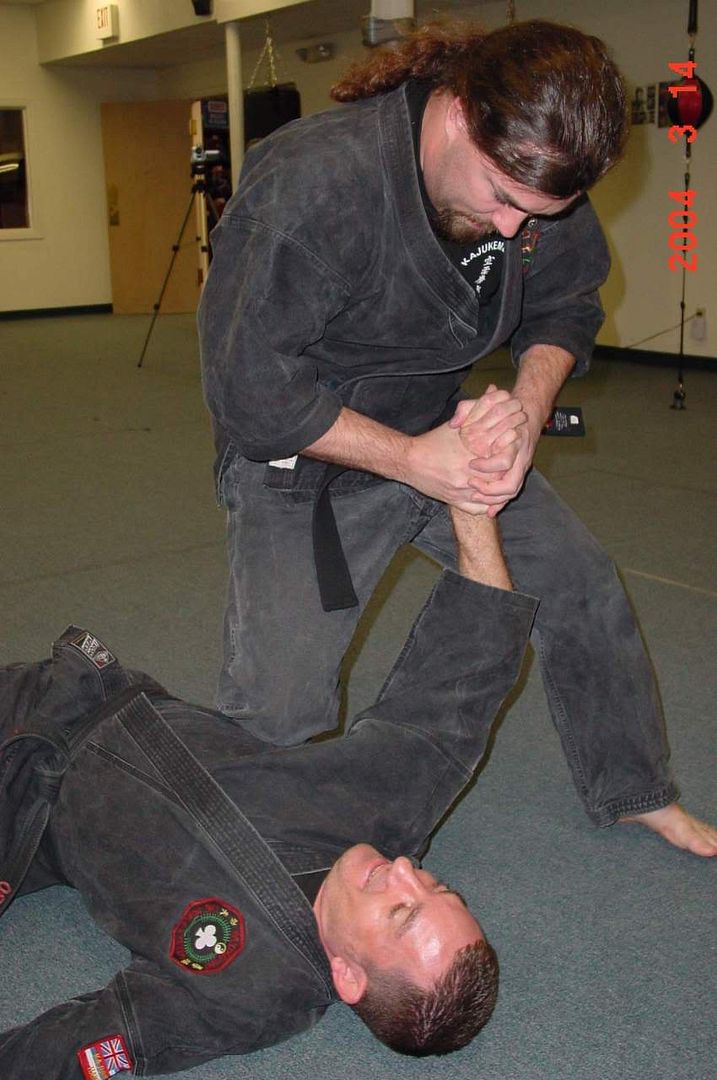
This is the area where I have the most difficulty visualising locks working in practice. I can see how I may get a wrist or arm lock applied if the attackers first move was a grab to my wrist, arm, lapel or even throat. If I was quick enough I could get a wrist or arm lock straight on. I can see that working, probably because it best reflects the way I’ve been training in joint locking techniques.

However, if I miss that opportunity and the assault continues I then have to wait for an opening or opportunity to get a lock on.  OpenHand suggests creating that opportunity rather than waiting for it but didn’t explain how one does that. Journeyman advised to always slap the attacker in the face before applying a lock to distract them from what you are about to do and therefore lower their resistance to the technique. I suppose this is a way of ‘creating the opportunity.’

It seems to me that though it may be possible to create the opportunity to apply a lock one shouldn’t merely wait for an opening.  If you are thinking too much about whether or not you can get a lock on then you may not remain ‘in the moment’ during the assault and respond with whatever technique is most appropriate at that point in time. Creating the opportunity to apply the lock seems the best way and I would welcome any other suggestions on how to do that…

Does size matter?

I suggested in my last post that I felt disadvantaged in a self-defence situation by my small size; that techniques, including locks, may not work effectively for me. A couple of commenters, OpenHand and Journeyman, disagreed with this view point saying that size and strength differences between attacker and defender shouldn’t matter. I have heard others say the same thing. However, experience, both my own and other ‘small’ people that I know suggest that size does make a difference.

In my opinion it’s not so much height differences between attacker and defender that matter (though they matter a bit) but differences in overall mass, particularly when it comes to any form of grappling technique. When I look around my jujitsu club the most proficient people are the ones with greatest mass, whether that mass comes from sheer height and muscle or just surplus body weight (i.e. fat). Even the black belt women in the club are stocky lasses, no taller than me but much heavier. Small skinnies like me just can’t cut the mustard in a grappling/throwing  art when we are pitted against a much heavier opponent.

In all sports and physical activities different body forms suit different sports. Sprinters and swimmers are generally tall and muscular, long distance runners are smaller and wiry, pole-vaulters are tall and slim, and jockeys are small and light. Good technique cannot make up for being the wrong body form for the activity you are doing. There’s a reason why wrestlers, boxers and MMA fighters fight in weight categories.

When it comes to locks my small, slim hands have a lot of difficulty applying a wrist lock to a large man’s muscular wrist. Journeyman stated that, “Just like you can’t flex your throat, you can’t strengthen your joints. Pounds of pressure required to dislocate a joint are largely the same, regardless of individual. It is for this reason that I recommend joint locks and manipulations for smaller individuals, regardless of sex.” 

I disagree with this – a lot of physiotherapy exercises are designed to strengthen the muscles that support joints thus making the joint more stable and resistant to injury. Though I agree that the amount of pressure needed to dislocate the joint may not differ between individuals the amount of pressure needed to initially twist a limb into position for a lock varies enormously. I often don’t have the strength to physically manoeuvre a muscular man’s wrist or shoulder into the position needed to lock the joint.  Also some men’s necks are so thick and muscular I cannot even place my hands around them or squeeze sufficiently hard to cause any discomfort at all!

Another problem I have dealing with a much larger opponent is applying a shoulder lock. I have to reach up to slip my hand under their armpit and onto their shoulder , and then push down from a very disadvantaged position – I’m actually pulling down rather than pushing because my centre of gravity is lower than theirs. “Bring them down to your height first,” you may say but honestly – that’s easier said than done!

So, what have I learnt about joint locking following your feedback?

1.       Locks may be applicable to me in some situations so I need to keep training with them (and learning counters to locks)

2.       Locks work best when you create the opportunity to apply them

3.       Size differences between attacker and defender may or may not be relevant – but if you want to convince me they are not then you’ll need to provide me with a good rational scientific explanation and with some tips on how small people can make techniques work on big people because I’m not yet convinced ;-)

Thanks again for everybody who contributed to the discussion on my previous post – a real team effort!


Bookmark and Share
Creative Commons License
This work is licensed under a Creative Commons Attribution-Noncommercial-Share Alike 2.0 UK: England & Wales License.

LinkWithin

Related Posts with Thumbnails